Equipotential Bonding Bar (EBB) Type 1
- Universal Earth Reference Bar (ERB) enclose assembly
- Dimensions 300W x 400H x 77.5D mm
The Bender Type 1 Equipotential Bonding Busbar (EBB) is designed for medical imaging rooms, including X-ray, CT and angiography areas. It provides a central connection point for supplementary protective bonding, helping to equalise the potential differences between conductive parts within the patient area.
Designed and manufactured in the UK, the Type 1 EBB is suitable for Group 1 and Group 2 medical locations and can be integrated into critical care power systems incorporating Bender Medical IT and UPS equipment.
Equipotential bonding plays an important role in maintaining electrical safety within patient environments by helping to limit touch voltages and reduce the risk of electric shock.
The Type 1 EBB provides a central connection point for protective earthing conductors, extraneous conductive parts, exposed conductive parts and supplementary equipotential bonding connections within the patient area.
Bender EBBs are arranged to enable single conductor connections, clear identification and easier fault finding, supporting periodic inspection, testing and maintenance, helping to minimise disruption and infection control issues.
For Group 1 and Group 2 medical locations, the resistance between any two conductive parts must meet the requirements of BS 7671:2018 Amendment 4 Regulation 710.415.2.2 and must not exceed 0.20 Ω. The datasheet also specifies 0.10 Ω for individual cables from the EBB to any point in the patient area.
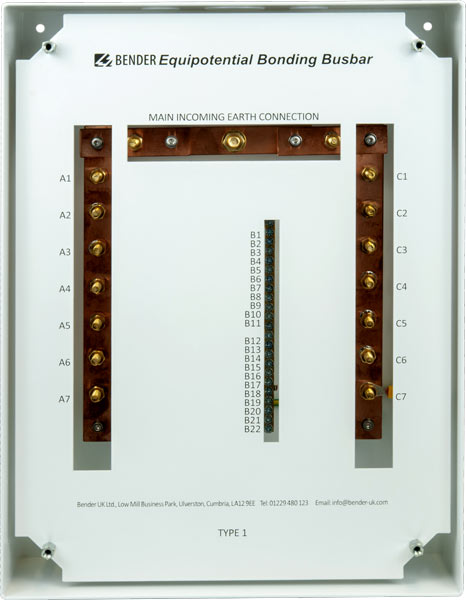
- Universal Earth Reference Bar (ERB) enclose assembly
- Dimensions 300W x 400H x 77.5D mm
The Bender Type 1 Equipotential Bonding Busbar (EBB) is designed for medical imaging rooms, including X-ray, CT and angiography areas. It provides a central connection point for supplementary protective bonding, helping to equalise the potential differences between conductive parts within the patient area.
Designed and manufactured in the UK, the Type 1 EBB is suitable for Group 1 and Group 2 medical locations and can be integrated into critical care power systems incorporating Bender Medical IT and UPS equipment.
Equipotential bonding plays an important role in maintaining electrical safety within patient environments by helping to limit touch voltages and reduce the risk of electric shock.
The Type 1 EBB provides a central connection point for protective earthing conductors, extraneous conductive parts, exposed conductive parts and supplementary equipotential bonding connections within the patient area.
Bender EBBs are arranged to enable single conductor connections, clear identification and easier fault finding, supporting periodic inspection, testing and maintenance, helping to minimise disruption and infection control issues.
For Group 1 and Group 2 medical locations, the resistance between any two conductive parts must meet the requirements of BS 7671:2018 Amendment 4 Regulation 710.415.2.2 and must not exceed 0.20 Ω. The datasheet also specifies 0.10 Ω for individual cables from the EBB to any point in the patient area.
Features
- Designed for medical imaging rooms, including X-ray, CT and angiography areas
- 400 A copper busbar
- 300 × 400 × 77.5 mm enclosure
- 20 × 10 mm main copper bar
- 8 × 8 mm central bar
- Mild steel back box with a white powder-coated finish
- Available in flush or surface-mounted configurations
- Fixed stud connections with associated hardware supplied for cable termination
- 8 Nm connection torque setting
- Custom variants available on request