Equipotential Bonding Bar (EBB) Type 2
- Multi Patient Earth Reference Bar (ERB) enclose assembly
- 300W x 400H x 77.5D mm
Type 2 Equipotential Bonding Busbar (EBB) is designed for multi-patient medical environments, including recovery areas, wards and other locations where several patients are treated or accommodated in close proximity.
The Type 2 EBB provides a central connection point for supplementary protective bonding within the patient environment, helping to equalise potential differences between conductive parts and reduce the risk of electric shock by limiting touch voltages.
It is suitable for Group 1 and Group 2 medical locations and supports electrical installations designed in accordance with BS 7671:2018 Amendment 4:2026 Section 710, HTM 06-01:2017, IEC 60364-7-710:2021 and IET Guidance Note 7 Section 9.
In medical locations, protective earthing conductors, extraneous-conductive parts, exposed conductive parts and supplementary equipotential bonding connection points within the patient area are connected to an EBB linked to the medical location earthing system.
This helps maintain equipotential conditions around the patient and minimise potentially hazardous touch voltages. Conductive parts intended to remain isolated from earth should not be connected to the EBB.
The Type 2's multi-patient configuration makes it particularly suited to:
- Recovery areas
- Hospital wards
- Multi-bed patient areas
- Other Group 1 and Group 2 locations where several patients are treated or accommodated in close proximity
Bender EBBs are designed to be positioned inside or directly outside the medical location they serve, below ceiling level.
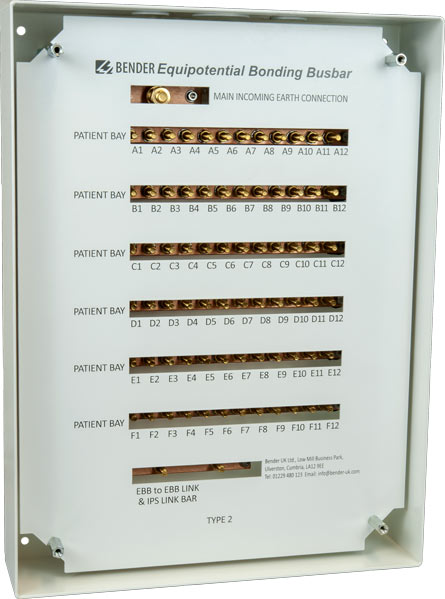
- Multi Patient Earth Reference Bar (ERB) enclose assembly
- 300W x 400H x 77.5D mm
Type 2 Equipotential Bonding Busbar (EBB) is designed for multi-patient medical environments, including recovery areas, wards and other locations where several patients are treated or accommodated in close proximity.
The Type 2 EBB provides a central connection point for supplementary protective bonding within the patient environment, helping to equalise potential differences between conductive parts and reduce the risk of electric shock by limiting touch voltages.
It is suitable for Group 1 and Group 2 medical locations and supports electrical installations designed in accordance with BS 7671:2018 Amendment 4:2026 Section 710, HTM 06-01:2017, IEC 60364-7-710:2021 and IET Guidance Note 7 Section 9.
In medical locations, protective earthing conductors, extraneous-conductive parts, exposed conductive parts and supplementary equipotential bonding connection points within the patient area are connected to an EBB linked to the medical location earthing system.
This helps maintain equipotential conditions around the patient and minimise potentially hazardous touch voltages. Conductive parts intended to remain isolated from earth should not be connected to the EBB.
The Type 2's multi-patient configuration makes it particularly suited to:
- Recovery areas
- Hospital wards
- Multi-bed patient areas
- Other Group 1 and Group 2 locations where several patients are treated or accommodated in close proximity
Bender EBBs are designed to be positioned inside or directly outside the medical location they serve, below ceiling level.
Features
- Designed specifically for multi-patient medical environments, including wards and recovery areas.
- Suitable for Group 1 and Group 2 medical locations.
- 200 A copper busbar with a 20 × 5 mm main copper bar and 12 × 4 mm sub copper bar.
- Available in flush or surface-mounted versions.
- 300 × 400 × 77.5 mm mild-steel enclosure with a white powder-coated finish.
- Fixed connection points designed to support simple cable termination and easier fault finding.
- 8 Nm connection torque setting.
- Standard variants available from stock and custom variants available on request.
- Supports installations designed in accordance with BS 7671:2018 Amendment 4:2026 Section 710, HTM 06-01:2017 and IET Guidance Note 7 Section 9.