UPS Battery Systems
Battery Types
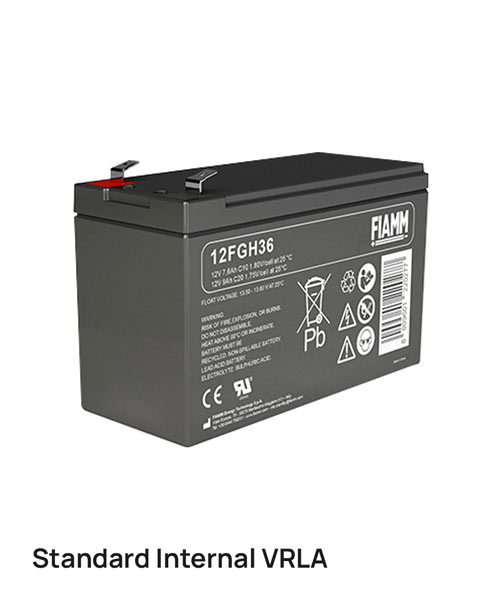
Standard Internal VRLA
Typically fitted Internal to UPS or external matching battery boxes
low cost, can be pre-built, non-HTM
Push fit connections
5yr design life & 10yr design life options
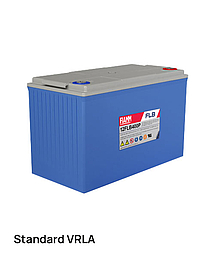
Standard VRLA
A proven and widely used battery technology for small to large installations. Standard VRLA batteries are competitively priced, readily available, and offered in a broad range of specifications. Our typical selection is a 10–12 year design-life block with fire-retardant V0 casing and screwed terminal inserts.
Design Life
10-12 yrs @ 20degC
7 yrs @ 25degC
3-4 yrs @ *30degC (*this temp is best avoided & would void any warranty)
+ FR Casing
+ HTM Complaint
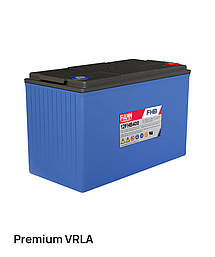
Premium VRLA
Fast becoming the new “standard” for medium to large systems, providing an extended design life and higher temperature tolerance. This enables cost savings with respect to battery replacement timescales and ongoing cooling requirements.
Design Life
15+ yrs @ 20degC
12+ yrs @ 25degC
10 yrs @ 30degC
+ Higher temp tolerant
+ Longer design life
+ FR casing
+ HTM complaint
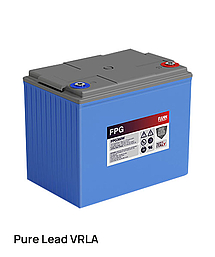
Pure Lead VRLA
Pure-Lead battery solution also provides the added advantage of up to a 24M shelf life (avoiding any complications with the typical 6M recharge requirement) as well as +10% increase in power density, allowing for improved battery footprints when compared to standard VRLA.
Design Life
15 yrs @ 20degC
12 yrs @ 25degC
+ 24M shelf life (low self-discharge)
+ 10% increased power density (smaller footprints)
+ FR casing
+ HTM complaint
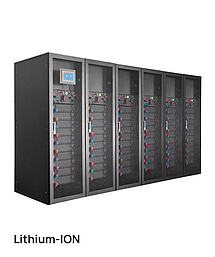
Lithium-ION
Although typically more expensive, lithium-ion batteries are well suited to applications requiring frequent cycling, high-rate performance, advanced operating modes such as peak shaving, or where space and temperature limitations are significant.
Design Life Extended life of 15+ years
High Power Density Reduced weight & footprint
High Temperature Tolerance Possible cost savings for cooling reduction
High Number of Discharge Cycles Capable of 11,000 cycles vs 300 for traditional lead acid
Recharge Faster recharge & reduced self-discharge rate
Battery Monitoring Embedded real-time advanced management & monitoring system
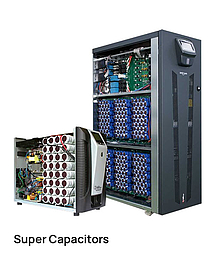
SuperCapacitors
Eco-friendly, battery-free alternative to standard UPS systems. Suitable for facilities prone to very short & frequent power interruptions.
+ 1s to 1min backup
+ Very high no. of discharge cycles (up to 1 million)
+ No need for any environmental control
+ Eco-friendly, battery free option
+ Reduced footprint & weight
+ Very long life (up x10 compared to standard VRLA batteries)
Design Life vs Service Life
UPS battery design life can range from 3–5 years to as much as 20 years, depending on the battery technology, application, and operating environment.
A manufacturer’s stated “design life” is not a guaranteed “service life”. Actual battery life depends on several factors, including the environment, temperature, maintenance regime, number and depth of discharge cycles, and charging conditions.
Based on our experience, a good-quality battery with a 10–12 year design life is typically expected to require replacement after approximately 8 years. Although it may operate for the full 10 years, this cannot be guaranteed by Bender UK or the battery manufacturer. For critical systems, particularly life safety applications, we recommend planning and budgeting for battery replacement in advance to minimise risk to the load and help prevent system failures.
Battery Sizing
All batteries, regardless of technology used, will degrade over their operational life. For VRLA products, this is typically a 20% reduction in performance. If the design load is 100kW for 60 mins, at end of life, the system would support 100kW for 48mins (or 80kW for 60mins). This battery sizing is very common and may be referred to as SOL (Start of Life).
To compensate for this, it is possible to oversize the battery from day 1, so when new it would achieve at least 72 mins at the design load, meaning that at the end of life it will become 60 mins. This of course will have a footprint and commercial impact, however, would be essential for compliance to EN50171 when an application is considered as “life safety”. This battery sizing may be referred to as EOL (End of Life).
When sizing a battery system, UPS DC-AC efficiency must be included in the calculation to ensure the required runtime is achieved. Selecting a higher-efficiency UPS can therefore reduce the required battery footprint and overall battery cost.
Adjusting the DC bus can significantly affect the required battery footprint and cost. At lower power ratings, we have UPS systems that are designed for a fixed 15 or 20-block string arrangement. However, our medium to large systems offer a wide DC bus window, typically from 30 to 50 blocks. This flexibility allows batteries to be sized more accurately and, in some cases, can deliver a significant commercial benefit.


Battery Types
Standard Internal VRLA
Typically fitted Internal to UPS or external matching battery boxes
low cost, can be pre-built, non-HTM
Push fit connections
5yr design life & 10yr design life options
Standard VRLA
A proven and widely used battery technology for small to large installations. Standard VRLA batteries are competitively priced, readily available, and offered in a broad range of specifications. Our typical selection is a 10–12 year design-life block with fire-retardant V0 casing and screwed terminal inserts.
Design Life
10-12 yrs @ 20degC
7 yrs @ 25degC
3-4 yrs @ *30degC (*this temp is best avoided & would void any warranty)
+ FR Casing
+ HTM Complaint
Premium VRLA
Fast becoming the new “standard” for medium to large systems, providing an extended design life and higher temperature tolerance. This enables cost savings with respect to battery replacement timescales and ongoing cooling requirements.
Design Life
15+ yrs @ 20degC
12+ yrs @ 25degC
10 yrs @ 30degC
+ Higher temp tolerant
+ Longer design life
+ FR casing
+ HTM complaint
Pure Lead VRLA
Pure-Lead battery solution also provides the added advantage of up to a 24M shelf life (avoiding any complications with the typical 6M recharge requirement) as well as +10% increase in power density, allowing for improved battery footprints when compared to standard VRLA.
Design Life
15 yrs @ 20degC
12 yrs @ 25degC
+ 24M shelf life (low self-discharge)
+ 10% increased power density (smaller footprints)
+ FR casing
+ HTM complaint
Lithium-ION
Although typically more expensive, lithium-ion batteries are well suited to applications requiring frequent cycling, high-rate performance, advanced operating modes such as peak shaving, or where space and temperature limitations are significant.
Design Life Extended life of 15+ years
High Power Density Reduced weight & footprint
High Temperature Tolerance Possible cost savings for cooling reduction
High Number of Discharge Cycles Capable of 11,000 cycles vs 300 for traditional lead acid
Recharge Faster recharge & reduced self-discharge rate
Battery Monitoring Embedded real-time advanced management & monitoring system
SuperCapacitors
Eco-friendly, battery-free alternative to standard UPS systems. Suitable for facilities prone to very short & frequent power interruptions.
+ 1s to 1min backup
+ Very high no. of discharge cycles (up to 1 million)
+ No need for any environmental control
+ Eco-friendly, battery free option
+ Reduced footprint & weight
+ Very long life (up x10 compared to standard VRLA batteries)
Design Life vs Service Life
UPS battery design life can range from 3–5 years to as much as 20 years, depending on the battery technology, application, and operating environment.
A manufacturer’s stated “design life” is not a guaranteed “service life”. Actual battery life depends on several factors, including the environment, temperature, maintenance regime, number and depth of discharge cycles, and charging conditions.
Based on our experience, a good-quality battery with a 10–12 year design life is typically expected to require replacement after approximately 8 years. Although it may operate for the full 10 years, this cannot be guaranteed by Bender UK or the battery manufacturer. For critical systems, particularly life safety applications, we recommend planning and budgeting for battery replacement in advance to minimise risk to the load and help prevent system failures.
Battery Sizing
All batteries, regardless of technology used, will degrade over their operational life. For VRLA products, this is typically a 20% reduction in performance. If the design load is 100kW for 60 mins, at end of life, the system would support 100kW for 48mins (or 80kW for 60mins). This battery sizing is very common and may be referred to as SOL (Start of Life).
To compensate for this, it is possible to oversize the battery from day 1, so when new it would achieve at least 72 mins at the design load, meaning that at the end of life it will become 60 mins. This of course will have a footprint and commercial impact, however, would be essential for compliance to EN50171 when an application is considered as “life safety”. This battery sizing may be referred to as EOL (End of Life).
When sizing a battery system, UPS DC-AC efficiency must be included in the calculation to ensure the required runtime is achieved. Selecting a higher-efficiency UPS can therefore reduce the required battery footprint and overall battery cost.
Adjusting the DC bus can significantly affect the required battery footprint and cost. At lower power ratings, we have UPS systems that are designed for a fixed 15 or 20-block string arrangement. However, our medium to large systems offer a wide DC bus window, typically from 30 to 50 blocks. This flexibility allows batteries to be sized more accurately and, in some cases, can deliver a significant commercial benefit.