

Enhancing safety in battery energy storage systems BESS with earth fault detection
Battery Energy Storage Systems (BESS) play a vital role in modernising energy networks and supporting the integration of renewable energy sources. As these installations continue to increase in size and complexity, maintaining electrical safety becomes increasingly important. One key consideration is the ability to detect and locate earth faults quickly, helping to minimise risks to personnel, equipment and system availability.
This article explores how insulation monitoring and earth fault location technologies can be applied within BESS and solar PV hybrid installations to support safe and reliable operation.
Earth Fault Detection in a BESS and Solar PV Hybrid System
Consider a medium-scale BESS installation with a capacity of 5 MW / 10 MWh, integrated with a solar PV installation and connected to the local electricity network. The system consists of lithium-ion battery banks, inverters, transformers, DC/DC converters and associated control systems.
To enhance safety and system reliability, a Bender earth fault detection and insulation monitoring solution can be integrated throughout the installation.
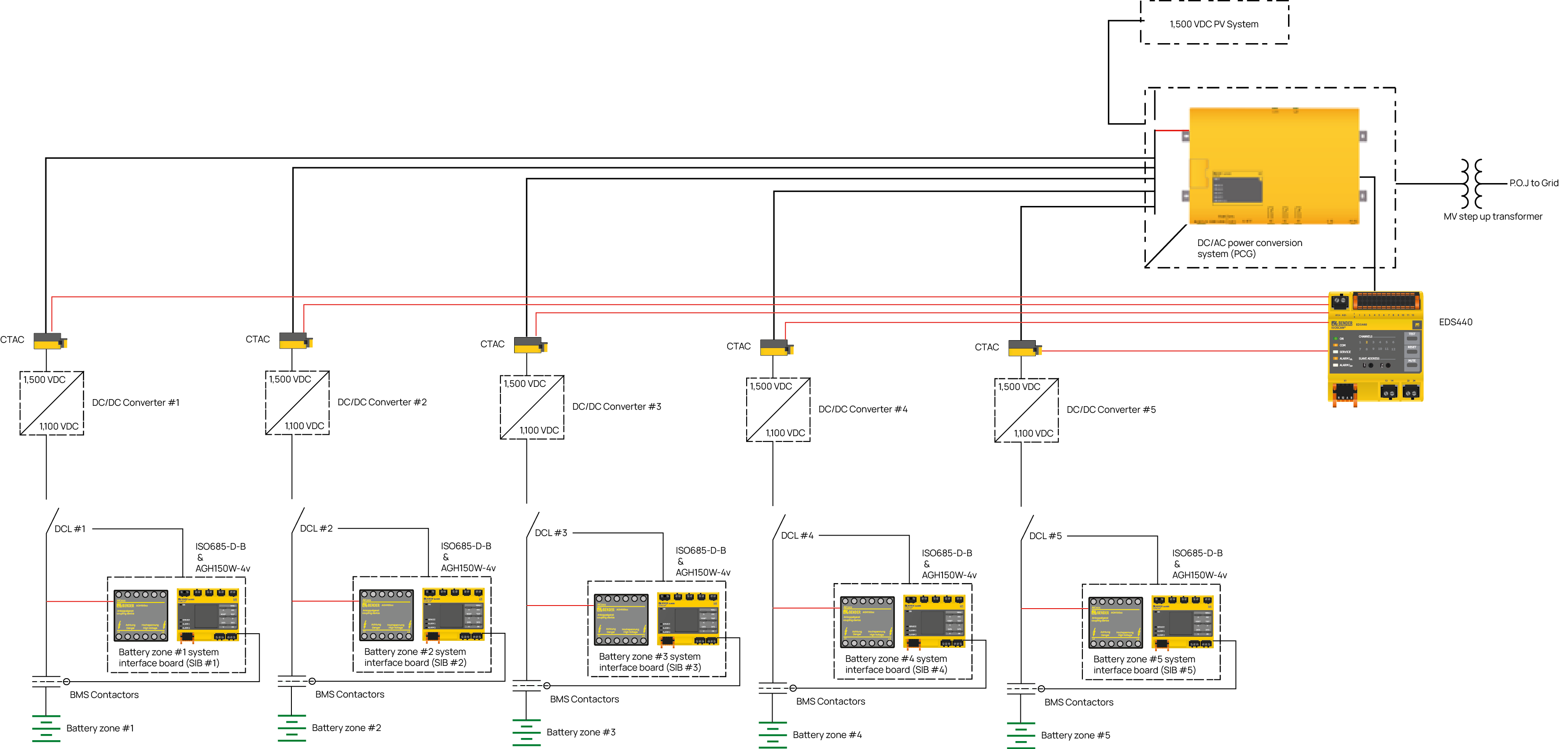
Earth Fault Detection Solution
Earth fault detection technology is designed to identify and locate insulation faults within electrical systems, reducing the risk of electric shock, fire and unexpected system downtime. Using continuous insulation monitoring, the system provides real-time information about the condition of the electrical installation, enabling maintenance teams to respond quickly when faults occur.
The earth fault detection system can be installed at several key points throughout the infrastructure:
- At the main connection point between the solar farm, BESS and the electricity network.
- Along the DC/DC converters.
- At each battery bank.
- On the PV side of the system. While insulation monitoring is active, earth fault location has not been implemented in this section.
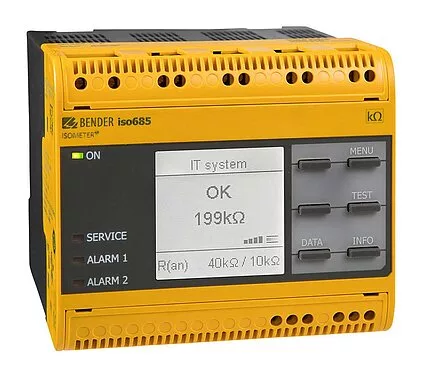
Using multiple insulation monitoring devices provides a comprehensive approach to fault detection and location. The iso1685 series, combined with pulsing modules and the EDS440 series, forms the core of the earth fault location system.
The iso1685 acts as the primary insulation monitoring device for the complete installation, including both the BESS and PV systems. When a reduction in insulation resistance is detected, the device automatically switches into pulse location mode. Working alongside the EDS440 and connected current transformers (CTs), the system can identify the affected battery bank and pinpoint the location of the fault.
Once the fault has been identified, operators can safely isolate the affected battery bank when operationally appropriate.
Additional insulation monitoring devices installed on each battery bank provide continuous monitoring when a bank has been isolated from the wider system. These devices remain in standby mode during normal operation and become active only when the DC switch is opened.
The iso685-D-B, used in conjunction with the AGH150W-4, provides continuous insulation monitoring of the isolated battery bank during maintenance and repair activities. This enables maintenance personnel to verify when the insulation fault has been rectified and confirms that the battery bank is safe to return to service.
Throughout operation, the system continuously measures insulation resistance and identifies potential earth faults before they develop into more significant safety or operational issues.
Benefits of Earth Fault Detection and Insulation Monitoring
Enhanced Safety
The system rapidly detects insulation faults and generates alarms, enabling operators to isolate affected sections before conditions escalate into a safety hazard.
Reduced Downtime
Fast fault detection and location reduce troubleshooting time, helping maintenance teams restore normal operation more quickly.
Data-Led Maintenance
Historical insulation resistance data can be recorded and analysed, helping identify trends and supporting proactive maintenance strategies.
Improved Compliance
Continuous insulation monitoring helps support compliance with relevant safety standards and industry requirements, while providing an additional layer of protection for personnel and equipment.
As Battery Energy Storage Systems continue to expand in support of renewable energy integration and grid resilience, effective electrical safety measures become increasingly important.
Continuous insulation monitoring and earth fault location technologies provide operators with early warning of developing faults, helping to protect personnel, maintain system availability and reduce maintenance costs. By identifying and locating faults quickly, these solutions support the safe, reliable and efficient operation of modern BESS and solar PV installations.
Looking ahead, advancements in artificial intelligence and predictive analytics may further enhance insulation monitoring by identifying patterns in historical data and predicting potential faults before they occur, enabling even more proactive maintenance strategies.
Protect BESS safety with continuous insulation monitoring
Discover how advanced earth fault detection and insulation monitoring technologies can help improve safety, reduce downtime and support the reliable operation of battery energy storage systems.
Talk to our experts